
SaaS and MVP Development
What Is Multi-Tenant SaaS Architecture?
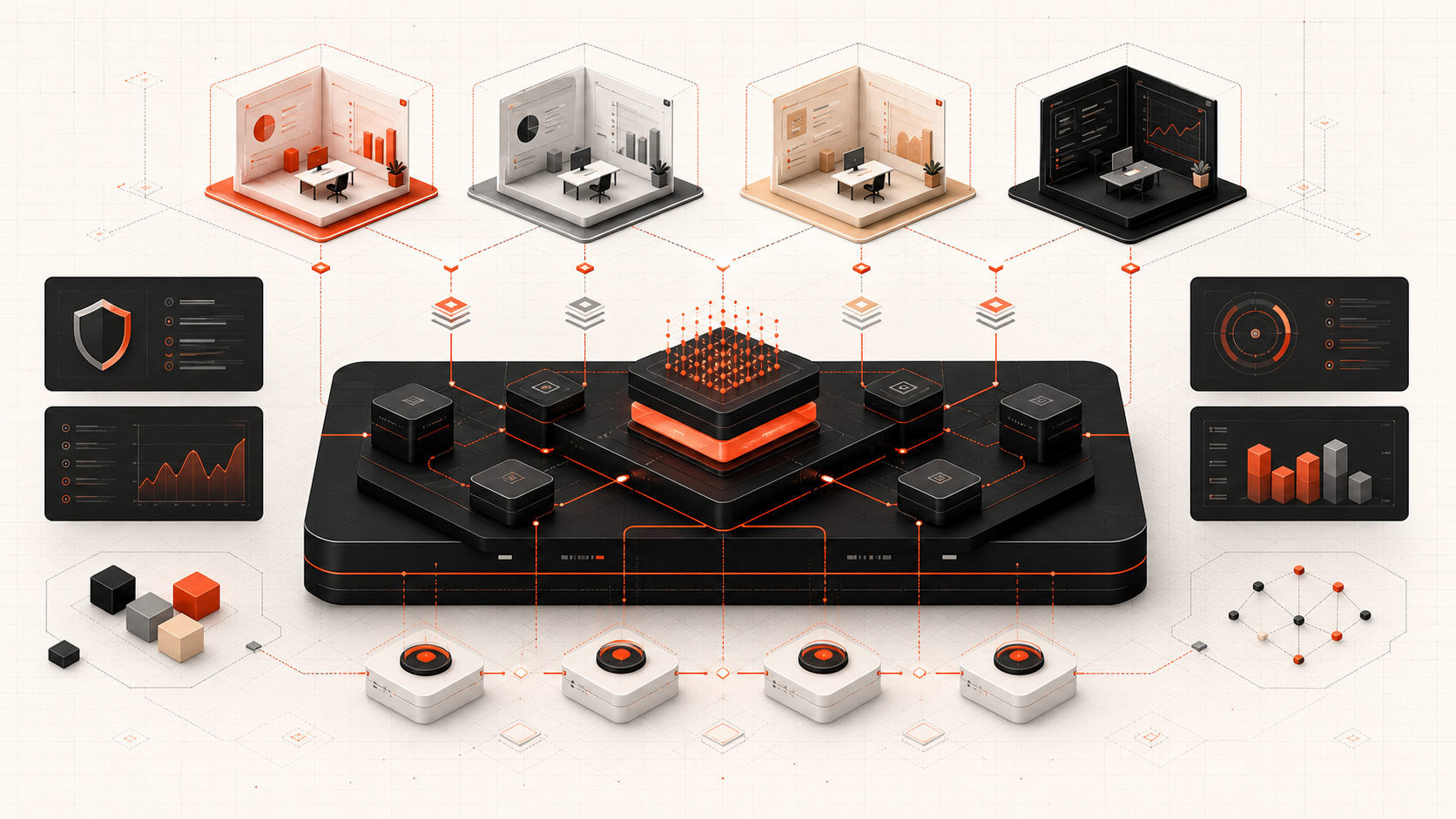
Multi-tenant SaaS architecture allows one software product to serve multiple customer organisations, called tenants, while keeping each tenant’s users, configuration, and data appropriately separated. Customers may share application infrastructure, databases, or services, but the product must preserve clear tenant context and prevent cross-tenant access. This architecture can improve operational efficiency and product consistency, but it introduces important decisions around isolation, scaling, customisation, security, and cost.
Section 1
What Is a Tenant?
A tenant is a customer account or organisation using the SaaS product. A tenant may contain one user, a company with many users, multiple departments, settings, subscriptions, and records. The tenant is the boundary around which access, billing, configuration, and data are organised.
For example, in a property-management SaaS, each property company may be a tenant. Its administrators invite staff, configure properties, and manage data that should not be visible to other property companies.
Tenant does not always mean one legal company. The business model may define a tenant as a workspace, franchise, school, clinic, branch group, or client account.
Related Service
Build a SaaS Foundation Around Real Tenancy Requirements
Criflet can help define tenant boundaries, roles, data strategy, subscriptions, provisioning, isolation, and growth architecture for a new or evolving SaaS product.
Discuss SaaS ArchitectureSection 2
Multi-Tenant vs Single-Tenant Architecture
In a multi-tenant model, customers share some or all application resources while the software separates their data and access logically. Updates can often be deployed to the shared product once, and operational tooling can manage customers through a unified platform.
In a single-tenant model, each customer receives a separate application instance, database, environment, or full stack. This can provide stronger isolation and customer-specific control but increases deployment, monitoring, upgrade, and infrastructure overhead.
The choice is a spectrum rather than a binary decision. A SaaS product can share the web layer while using separate databases, or use shared infrastructure for most customers and dedicated resources for a premium or regulated tier.
Section 3
Common Tenant Isolation Models
A pooled model shares application and data resources, with each record carrying a tenant identifier. This can be cost-efficient and scalable, but every query and access rule must preserve tenant context correctly.
A silo model gives each tenant dedicated resources, such as a separate database or application stack. Isolation is clearer, but provisioning, upgrades, observability, and cost management become more complex.
A bridge or hybrid model shares selected layers and isolates others. For example, the application may be shared while each tenant has a separate database. The right model depends on compliance, performance, customer expectations, operational capability, and pricing.
- Pool: shared resources with logical tenant separation.
- Silo: dedicated resources for each tenant.
- Bridge: a mixture of shared and dedicated layers.
- Tiered: different isolation levels for different plans or customers.
Section 4
Tenant Context Must Follow Every Request
After authentication, the system needs to know which tenant the user is acting within and what role they have there. Tenant context may come from the account session, token, subdomain, workspace selection, or another controlled mechanism.
That context should scope database queries, file paths, cache keys, background jobs, search indexes, notifications, analytics, and integrations. A single missing filter can create a severe data-exposure incident.
Tenant isolation is separate from basic authentication. A user can be correctly signed in and still receive data from the wrong tenant if the architecture does not enforce boundaries consistently.
Section 5
Data Storage Strategies
A shared database with shared tables stores records from multiple tenants together and uses a tenant identifier for separation. It can simplify operations and support efficient shared infrastructure, but demands strong application-level and database-level safeguards.
A shared database with separate schemas gives each tenant a logical namespace. Separate databases provide stronger isolation and may make customer-specific backup, restore, or residency easier, but increase connection and operational management.
Data strategy should consider scale, noisy-neighbour risk, reporting, backup and restore, regional requirements, migration, customer offboarding, and the ability to move a tenant between tiers.
Section 6
Tenant Onboarding and Provisioning
A SaaS product needs a reliable process for creating a tenant, assigning an owner, applying a plan, creating default settings, and inviting users. In more isolated models, provisioning may also create infrastructure, databases, keys, or storage boundaries.
Provisioning should be repeatable and observable. Partial setup can leave a customer with an account that exists in billing but not in the application, or with resources that were created but never activated.
Offboarding also matters. Define data export, retention, deletion, subscription closure, user access, and resource cleanup.
Section 7
Configuration Without Creating Separate Products
SaaS customers often want branding, workflows, fields, permissions, notifications, integrations, or reports tailored to their organisation. The architecture should distinguish configuration from custom code.
Feature flags, plan entitlements, configurable templates, role settings, and tenant-specific metadata can support variation while keeping one maintainable product. Excessive customer-specific branches make updates and testing difficult.
When a customer requires a fundamentally different process, decide whether it belongs in the shared product, a configurable extension, an integration, or a dedicated deployment.
Section 8
Scaling and Noisy-Neighbour Management
Shared infrastructure means one tenant’s workload can affect others. A large import, complex report, heavy API usage, or unusual traffic spike may consume shared resources. Rate limits, quotas, workload isolation, queues, caching, and capacity monitoring can reduce the risk.
Measure usage by tenant. This supports performance investigation, fair-use controls, pricing, and the ability to move demanding customers to more isolated resources.
Design background work and reporting carefully. Expensive operations should not block interactive requests for every customer.
Section 9
Security, Auditability, and Observability
Use secure authentication, role-based authorisation, explicit tenant checks, encrypted connections, secret management, backups, and controlled administrative access. Platform administrators with cross-tenant visibility require stronger safeguards and logging.
Logs and metrics should contain tenant context without unnecessarily exposing sensitive data. The operations team needs to investigate errors, performance, billing, and security events for one tenant without confusing them with another.
Test tenant isolation directly. Automated tests should attempt cross-tenant reads, updates, files, exports, search, and background operations—not only normal user journeys.
Section 10
When Multi-Tenant Architecture Is Appropriate
Multi-tenancy is appropriate when the product serves many customers through a standardised service, updates should reach customers consistently, and shared operations support the business model. It is common in B2B SaaS, collaboration tools, vertical software, and subscription platforms.
A dedicated or hybrid model may be preferable when customers require strict isolation, custom infrastructure, regional deployment, specialised performance, or contractual controls. These benefits should be reflected in pricing because they increase operating complexity.
Architecture should follow the first market and credible growth path. An early SaaS product does not need every enterprise isolation tier on day one, but it should avoid data and identity decisions that make safe expansion difficult.
Next Step
Design Multi-Tenancy as a Product and Security Decision
Tell Criflet who your customers are, how their users and data should be separated, and what growth or enterprise requirements you expect. We will help define a practical architecture.
Contact CrifletFrequently Asked Questions
Common questions about this topic.
Not necessarily. Customers may share a database, use separate schemas, use separate databases, or use a hybrid model. Multi-tenancy describes serving multiple tenants through one SaaS product and operating model.
It can be secure when tenant context and isolation are explicitly enforced across identity, data, files, background work, administration, and testing. Weak implementation can create serious exposure.
Tenant isolation is the set of architectural and security controls that prevents one tenant from accessing or affecting another tenant’s resources beyond intended shared behaviour.
Yes. A hybrid or tiered model can provide dedicated resources for customers with stronger isolation, performance, residency, or contractual needs.
If the product will serve separate customer organisations, the MVP should establish a safe tenant model. It can keep isolation and configuration simple while leaving a path to scale.